

Modbus TCP Guide for Industrial Communication
Modbus TCP is a widely adopted industrial communication protocol that enables reliable data exchange over Ethernet networks. As Ethernet infrastructure has become standard in modern facilities, modbus tcp has evolved into a key technology for integrating PLCs, SCADA systems, HMIs, and field devices within Industry 4.0 environments.
Unlike serial-based Modbus RTU, modbus tcp connection operates over TCP/IP, allowing faster communication, higher data throughput, and easier network scalability. This makes it ideal for real-time monitoring, centralized control, and distributed automation architectures.
In this guide, modbus tcp explained covers its structure, communication model, port configuration, and implementation in industrial systems. Understanding its fundamentals helps engineers design secure and efficient Ethernet-based automation networks.
What Is Modbus TCP?
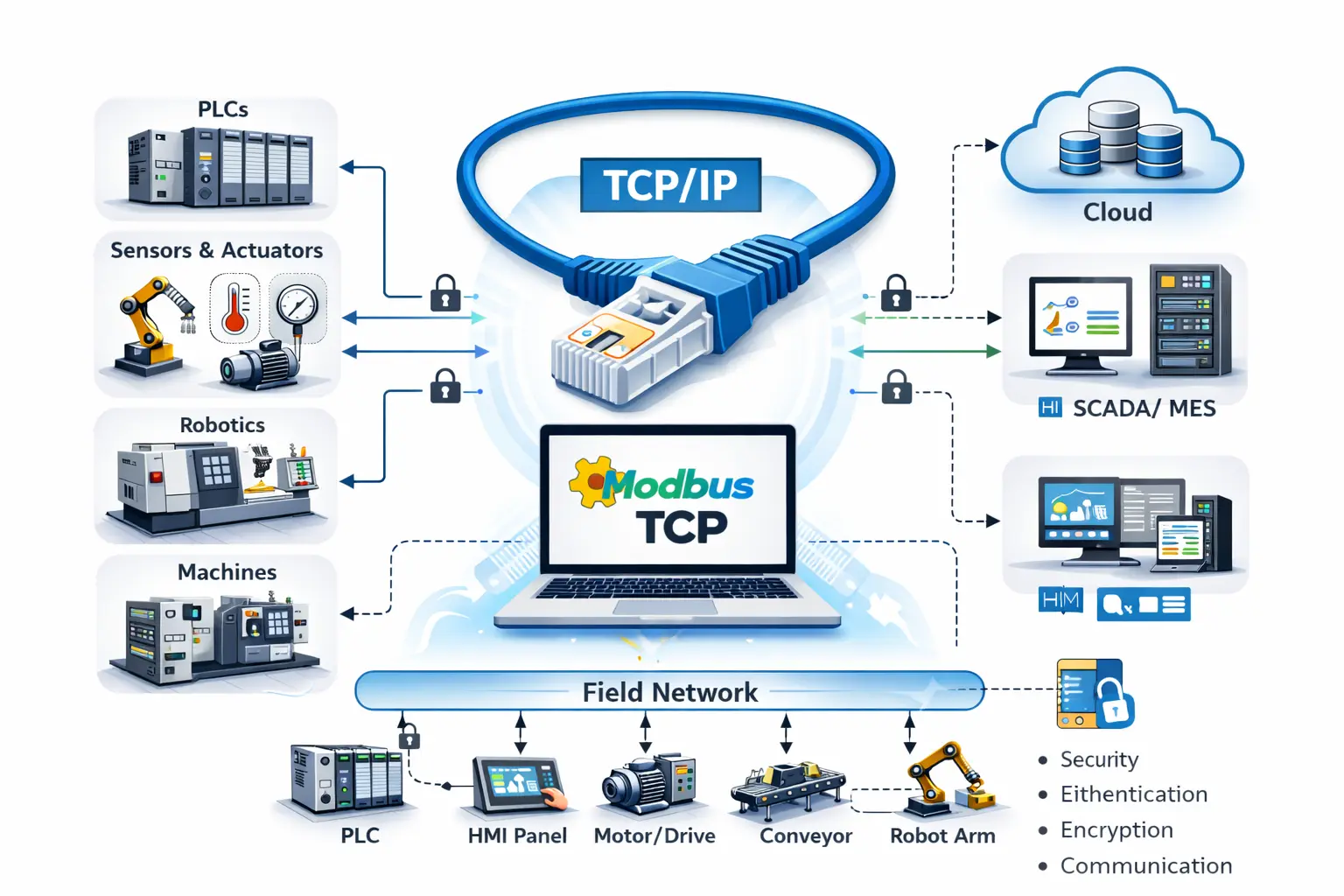
Modbus TCP is an Ethernet-based industrial communication protocol that enables devices to exchange data over TCP/IP networks. It is essentially an extension of the traditional Modbus protocol, adapted to operate within standard Ethernet infrastructure.
A modbus tcp connection allows PLCs, SCADA systems, HMIs, and industrial controllers to communicate using client-server architecture instead of the master-slave model used in serial communication. This improves scalability, speed, and network flexibility.
When modbus tcp explained in simple terms, it can be described as Modbus messaging encapsulated inside TCP/IP packets. This design eliminates the need for serial wiring while maintaining the familiar Modbus data structure. As a result, modbus tcp has become a core communication standard in modern industrial automation and smart factory environments.
What Does “Protocolo Modbus TCP” Mean?
The term protocolo modbus tcp refers to the Spanish expression for the Modbus TCP communication protocol used in Ethernet-based industrial networks. It describes the same modbus tcp standard that enables data exchange between automation devices over TCP/IP infrastructure.
In technical terms, protocolo modbus tcp defines how Modbus messages are encapsulated within Ethernet frames and transmitted through a modbus tcp connection. While the physical layer differs from serial Modbus, the application layer structure remains consistent, including function codes and register-based data addressing.
When modbus tcp explained in multilingual industrial environments, understanding terminology such as protocolo modbus tcp is important for documentation, international projects, and cross-border system integration.
How Does Modbus TCP Work?
Modbus TCP works by transmitting Modbus data frames over a standard Ethernet network using the TCP/IP protocol stack. Instead of serial communication, devices establish a modbus tcp connection through IP addresses, enabling fast and scalable industrial communication.
In this architecture, communication follows a client-server model. The client (typically a PLC, SCADA system, or industrial PC) sends a request to a server device, which then responds with the requested data. This structure improves flexibility compared to serial networks and allows multiple simultaneous connections.
When modbus tcp explained technically, the protocol encapsulates traditional Modbus function codes and register data inside a TCP frame. This ensures compatibility with legacy Modbus structures while leveraging the speed and reliability of Ethernet-based infrastructure.
How Is Modbus TCP Communication Structured?
Modbus TCP communication is structured around a client-server model operating over Ethernet. Each modbus tcp connection is established using an IP address and the designated tcp modbus port, ensuring reliable data exchange between devices.
The protocol frame consists of a Modbus Application Header (MBAP) and a Protocol Data Unit (PDU). The MBAP header includes transaction identifier, protocol identifier, length field, and unit identifier. The PDU contains the function code and data field, similar to traditional Modbus structure.
When modbus tcp explained from a structural perspective, it maintains the same logical data model as serial Modbus but removes the need for CRC since TCP/IP already provides error checking. This makes modbus tcp both efficient and highly scalable for modern industrial Ethernet networks.
How Are Modbus TCP Messages Transmitted Over Ethernet?
Modbus TCP messages are transmitted over Ethernet using the standard TCP/IP protocol stack. When a modbus tcp connection is established, the client device sends a request packet to the server’s IP address through the designated tcp modbus port.
Each message contains the MBAP header and the Modbus Protocol Data Unit. The TCP layer ensures reliable delivery through packet sequencing, acknowledgment, and retransmission mechanisms. This eliminates the need for additional checksum handling at the Modbus level.
When modbus tcp explained in network terms, the protocol leverages Ethernet switches and structured cabling to enable high-speed and long-distance communication. As a result, modbus tcp supports real-time monitoring and seamless integration within modern industrial Ethernet infrastructures.
Which TCP Modbus Port Is Used?
In Modbus TCP communication, the standard tcp modbus port used is Port 502. This port is officially assigned by the Internet Assigned Numbers Authority (IANA) for modbus tcp traffic.
When a modbus tcp connection is established, the client device sends requests to the server’s IP address using Port 502 by default. This standardized configuration ensures compatibility between PLCs, SCADA systems, gateways, and other Ethernet-enabled industrial devices.
Because Port 502 is globally recognized for modbus tcp, most industrial controllers and network equipment are preconfigured to allow communication through this port. However, in secure or segmented networks, firewall rules and VLAN configurations must be properly adjusted to permit traffic.
Why Is Port 502 Used for Modbus TCP?
Port 502 is used for Modbus TCP because it is the officially registered tcp modbus port assigned by IANA for this protocol. This standardization ensures global interoperability between devices from different manufacturers operating within the same modbus tcp connection.
By reserving Port 502 exclusively for modbus tcp, network equipment such as routers, switches, and firewalls can easily identify and manage Modbus traffic. This simplifies configuration, improves compatibility, and reduces integration complexity in industrial environments.
When modbus tcp explained from a networking perspective, using a dedicated port allows consistent communication rules across automation systems. As a result, modbus tcp devices can connect seamlessly within structured Ethernet infrastructures without requiring custom port definitions.
How Is the TCP Modbus Port Configured in Networks?
The tcp modbus port, which is Port 502 by default, must be properly configured within the network infrastructure to ensure a stable modbus tcp connection. In most industrial systems, devices are preconfigured to communicate through Port 502, requiring minimal manual setup.
However, network administrators must allow traffic through this port in firewalls, managed switches, and routers. In segmented architectures using VLANs or industrial DMZ zones, routing rules should explicitly permit modbus tcp traffic between authorized devices.
When modbus tcp explained from a cybersecurity perspective, restricting access to the tcp modbus port is critical. Only trusted IP addresses should be allowed to establish connections, reducing the risk of unauthorized access to PLCs or SCADA systems.
How Is Modbus TCP Implemented in Industrial Systems?
Modbus TCP is implemented in industrial systems by integrating Ethernet-enabled PLCs, remote I/O modules, HMIs, and SCADA platforms within a unified network architecture. Each device is assigned an IP address, allowing a stable modbus tcp connection over standard industrial Ethernet infrastructure.
Implementation typically begins with network design, including IP planning and configuration of the tcp modbus port. PLCs or SCADA systems are configured as clients, while field devices operate as servers responding to data requests.
When modbus tcp explained in practical deployment terms, it enables centralized monitoring, real-time data acquisition, and seamless integration with MES and cloud platforms. Because modbus tcp uses widely supported Ethernet standards, it offers scalability and simplified maintenance for modern smart factory environments.
What Is a Modbus TCP App Used For?
A modbus tcp app is used to monitor, test, and manage devices communicating over a modbus tcp connection. These applications are typically installed on industrial PCs, tablets, or mobile devices to interact directly with PLCs, energy meters, gateways, and other Ethernet-enabled equipment.
A modbus tcp app allows users to read and write registers, simulate client requests, and verify device responses through the standard tcp modbus port. This makes it a valuable tool for commissioning, troubleshooting, and performance validation in industrial environments.
When modbus tcp explained from a practical perspective, such applications simplify diagnostics and reduce integration time. Many modern industrial platforms incorporate built-in modbus tcp app functionalities within SCADA or automation software to enhance visibility and control.
How Is Modbus TCP Used in SCADA Systems?
Modbus TCP is widely used in SCADA systems to enable real-time data acquisition and centralized control over Ethernet networks. Through a stable modbus tcp connection, SCADA software communicates with PLCs, remote I/O modules, and intelligent field devices.
Using the standard tcp modbus port (Port 502), SCADA platforms send read and write requests to collect operational data such as temperature, pressure, energy consumption, and equipment status. This data is then visualized on dashboards, stored for analysis, and used for alarm management.
When modbus tcp explained within SCADA architecture, it acts as the communication bridge between field-level devices and supervisory control systems. Because modbus tcp is scalable and widely supported, it remains a preferred protocol for modern industrial monitoring and smart factory applications.