

Modbus ASCII Guide for Serial Communication
Modbus ASCII is one of the earliest serial communication formats used in industrial automation systems to exchange data between controllers, sensors, and monitoring devices. It converts binary information into readable ASCII characters, making communication frames easier to interpret and debug compared to other Modbus transmission modes. Although newer formats exist, this method still appears in legacy industrial environments and certain low-speed serial communication applications where readability and reliability are prioritized.
In modern automation architectures, Modbus communication often connects programmable logic controllers (PLCs), remote terminal units (RTUs), drives, sensors, and supervisory systems through serial interfaces such as RS-232 or RS-485. The ASCII-based approach represents each byte of data as two ASCII characters, enabling technicians to visually inspect the transmitted messages. Because of this transparency, engineers working with serial diagnostics often rely on this method when troubleshooting communication issues in industrial networks.
What Is Modbus ASCII?
Understanding this communication format begins with examining its role in industrial automation. It represents a variation of the Modbus protocol designed for serial communication environments where clarity and compatibility are more important than transmission speed. Data is transmitted as ASCII characters rather than binary values, which simplifies interpretation but slightly increases message length.
The protocol is commonly used in older industrial equipment, embedded devices, and systems where debugging accessibility is critical. By converting each byte into human-readable ASCII characters, engineers can inspect communication frames through standard serial monitors. This readability makes it easier to diagnose configuration errors, address mismatches, and transmission faults during system setup or maintenance.
What Is Modbus ASCII Meaning in Industrial Systems?
What Is Modbus ASCII in industrial systems? It refers to a communication method where Modbus messages are encoded as ASCII text characters for transmission over serial interfaces. Each byte of information is represented by two ASCII characters, allowing engineers to directly view the transmitted data stream without specialized decoding tools.
In practical industrial environments, this approach is often used where diagnostic transparency is required. For example, maintenance technicians working on serial networks can monitor traffic through terminal software and immediately recognize addresses, function codes, and register values. This transparency is particularly helpful in older control infrastructures where advanced monitoring tools may not be available.
What Is the Modbus ASCII Protocol?
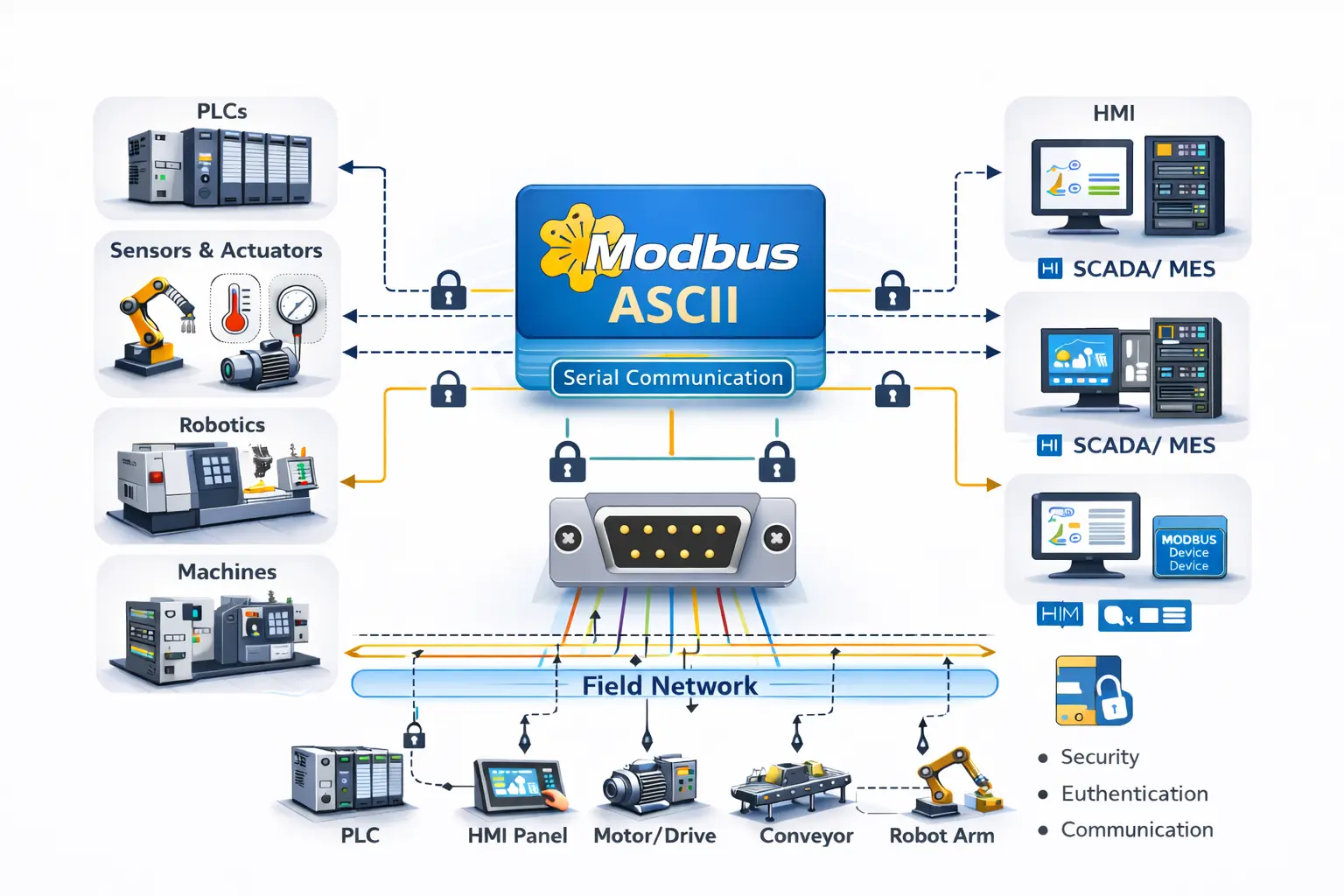
Modbus ASCII Protocol defines the communication rules that determine how devices exchange data using ASCII-encoded frames. It establishes the structure of messages, including the start character, address field, function code, data section, error checking mechanism, and message termination.
One of the defining elements of this protocol is its use of the colon character (:) to indicate the start of a frame and carriage return/line feed characters to mark the end of the message. Each byte is converted into two ASCII characters, which are then transmitted sequentially across the serial link. Although this increases the total number of transmitted characters, it allows communication frames to be easily interpreted using standard text-based monitoring tools.
How Does Modbus ASCII Work in Practice?
In practical implementations, industrial devices exchange information using a structured communication message known as a Modbus ASCII Frame. Each frame begins with a colon (:) that signals the start of transmission. This is followed by fields containing the device address, the requested function code, the data payload, and an error-checking value called the longitudinal redundancy check (LRC).
Once the frame is assembled, the transmitting device sends the ASCII-encoded characters through the serial communication line. The receiving device interprets the characters, converts them back into binary values, and processes the request. If the message passes the LRC validation and the address matches the device, it executes the requested operation and sends a response frame back to the master device.
How Is Modbus ASCII Different from Other Modbus Formats?
Different Modbus communication formats exist to accommodate varying industrial network requirements. Some formats prioritize speed, while others emphasize compatibility and readability. The ASCII-based implementation focuses on clarity, which distinguishes it from the binary-oriented formats used in modern automation systems.
Compared with other variations, ASCII-encoded communication produces longer message frames due to the character conversion process. However, the ability to visually inspect and interpret the transmitted information can simplify diagnostics and troubleshooting in industrial environments where technical accessibility is essential.
How Is Modbus ASCII Different from Modbus RTU?
The main difference between ASCII-based communication and RTU format lies in how the data is encoded and transmitted. RTU uses binary encoding, allowing messages to be transmitted more efficiently with fewer characters. This results in faster communication speeds and shorter message frames.
By contrast, ASCII-encoded communication converts each byte into readable characters, increasing message length but improving readability. This difference means that RTU is generally preferred for high-performance systems, while ASCII may be selected when easier diagnostics and compatibility with simple serial tools are required.
When Is Modbus ASCII Preferred over Modbus TCP?
Although Ethernet-based communication such as Modbus TCP is common in modern automation networks, ASCII serial communication can still be preferred in certain scenarios. Legacy equipment, low-speed serial networks, and environments without Ethernet infrastructure may still rely on serial communication protocols.
In such cases, engineers may choose ASCII Modbus implementations when system simplicity and diagnostic visibility are more important than network speed. Because the communication frames are readable through basic serial monitoring software, troubleshooting and maintenance tasks can often be completed more quickly in these environments.
What Types of Devices Support Modbus ASCII?
Many industrial devices designed for serial communication support this protocol format. These devices typically include programmable logic controllers, remote terminal units, industrial sensors, motor drives, and data acquisition modules. Because the protocol operates over common serial standards such as RS-232 and RS-485, it can be integrated into a wide range of industrial hardware.
In older automation systems especially, equipment manufacturers frequently implemented ASCII communication modes alongside RTU options. This allowed technicians to configure and diagnose devices using simple terminal programs. Even today, some industrial gateways and converters continue to support ASCII communication to maintain compatibility with legacy equipment.
What Are the Advantages and Limitations of Modbus ASCII?
One of the primary advantages of this communication format is its readability. Engineers can directly inspect the transmitted characters using basic serial monitoring tools, which simplifies troubleshooting and system diagnostics. This transparency can be especially valuable during system commissioning or when diagnosing communication errors.
However, the protocol also has limitations. Because each byte is transmitted as two ASCII characters, the resulting messages are longer than those used in binary formats. This increases transmission time and reduces overall communication efficiency. As a result, modern high-speed automation systems typically prefer more efficient protocols unless compatibility with older devices is required.
When Should Modbus ASCII Be Used in Industrial Projects?
Choosing the right communication protocol depends on system requirements, infrastructure, and device compatibility. ASCII-based communication is typically used in projects that involve legacy equipment or require simple serial communication diagnostics. Systems with limited bandwidth or low data-rate requirements may also benefit from its straightforward implementation.
In industrial modernization projects, engineers sometimes maintain ASCII communication when upgrading only part of an existing infrastructure. By preserving compatibility with older devices, organizations can gradually transition to newer protocols without replacing every component in the network simultaneously.